Tile and slate roofing in Georgia from Red Roofing & Gutters delivers homeowners the heirloom prestige of premium composite slate and tile with 50-year manufacturer warranties — installed with century-old craft and modern precision.
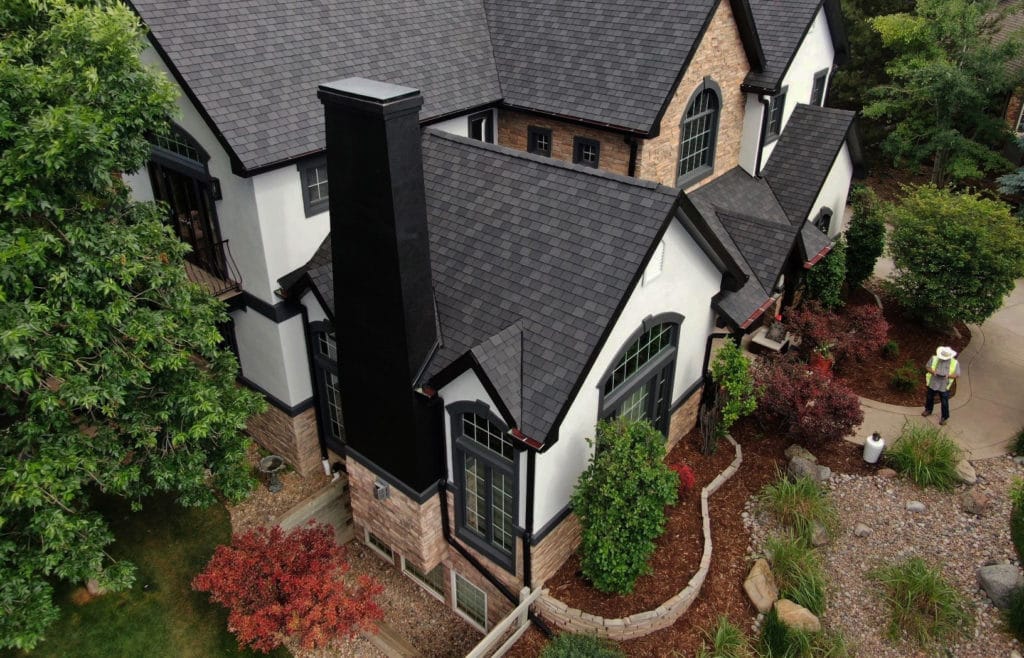
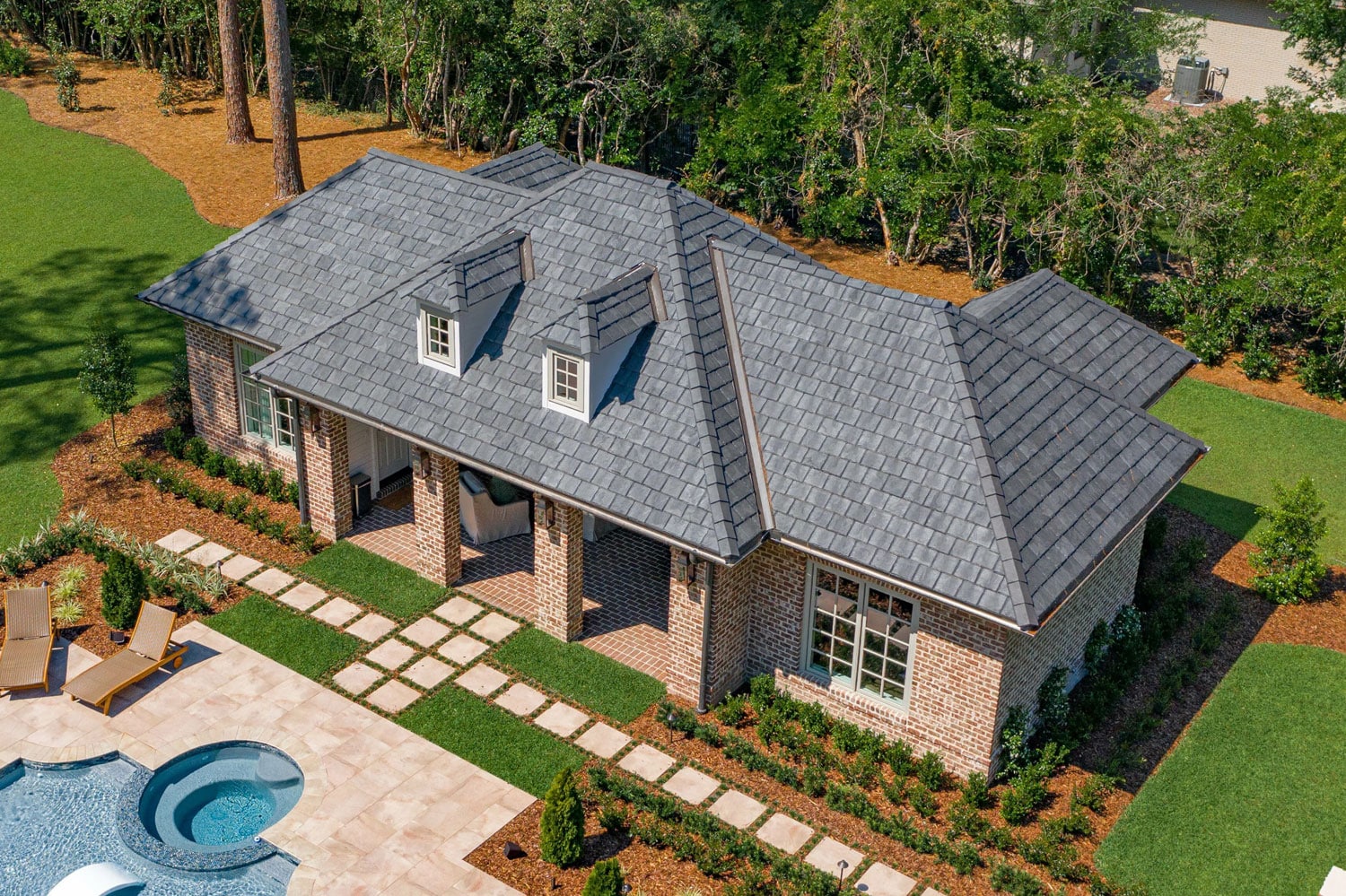
Lightweight composite tile and slate roofing in Georgia represents the next generation of premium roofing. Engineered from advanced polymers, these systems deliver the look, prestige, and performance of stone-quarried slate at a fraction of the weight — and without the structural retrofitting required for traditional materials.
At Red Roofing & Gutters, our lightweight composite division specializes in DaVinci, Brava, CeDUR, and stone-coated steel systems — delivering tile and slate roofing in Georgia with the heirloom appearance and 50-year warranty performance once reserved only for European estates, with none of the weight penalty.
Engineered polymer slate systems that deliver the look and prestige of stone-quarried slate at a fraction of the weight — with 50-year manufacturer warranties and zero structural retrofitting.
DaVinci, Brava, and CeDUR engineered polymer tiles — the leading material for tile and slate roofing in Georgia, delivering the look of natural slate at a fraction of the weight and cost.
Multi-width composite slate panels in graduated profiles — popular tile and slate roofing in Georgia choices that install faster than stone slate with the same architectural depth.
From mixed-profile estates to architectural-committee-bound communities — full tile and slate roofing in Georgia project planning, color matching, and HOA submissions.
From kiln-fired Spanish barrel tile to lightweight composite alternatives — Red Roofing & Gutters installs the full range of premium tile roofing systems for Georgia homes.
Kiln-fired clay tile in classic Spanish barrel and S-tile profiles — traditional tile and slate roofing in Georgia choices with Mediterranean character and century-long performance.
Color-through concrete tile delivers the look of clay with greater impact resistance and a wider color palette — a versatile tile and slate roofing in Georgia choice for any home style.
Steel tiles finished with stone granule coating — the fastest-growing tile and slate roofing in Georgia category, with the profile of clay or slate plus the agility of metal.
Brava polymer barrel tiles deliver the Mediterranean look of clay barrel for tile and slate roofing in Georgia projects, at a fraction of the weight — perfect for homes not engineered for traditional tile.
Engineered polymer tile mimics traditional clay and concrete profiles for tile and slate roofing in Georgia projects, without the structural weight burden of stone-based materials.
Brava and DaVinci shake tiles bring the warm character of hand-split cedar to tile and slate roofing in Georgia projects, with full fire and impact ratings cedar can't match.
For homeowners considering tile and slate roofing in Georgia, the most important decision isn't between brands — it's between two fundamentally different material philosophies. Traditional natural slate is quarried stone, mined from deposits primarily in Vermont, Virginia, and select European sources. It has been the choice of estate-grade homes for over five centuries and is justifiably considered the prestige standard in roofing. Modern composite slate is engineered polymer, molded directly from natural slate samples to replicate every chip, edge, and surface variation — but engineered to install at a fraction of the weight and cost.
At Red Roofing & Gutters, we deliver tile and slate roofing in Georgia across both categories, and we've been the choice of Madison, Lake Oconee, Greensboro, and Greater Atlanta homeowners for over two decades. The honest answer to which material is right for your home depends on factors most contractors won't take the time to walk you through. This guide is the conversation we have at every kitchen table — laid out in detail so you can make an informed decision before we even arrive for your free consultation.
Slate has been used as a roofing material in Europe since the 12th century. The earliest surviving slate roofs in Wales, England, and northern France are still functional today, having outlasted multiple stone wall replacements, three or four window replacements, and in some cases the original timber framing of the houses they protect. When American colonial-era builders selected slate for institutional and high-end residential roofs in the 1700s, they were borrowing a material whose performance had already been documented across hundreds of years of European weather.
The reason slate has remained the gold standard isn't aesthetic — though it is undeniably beautiful — it's mechanical. Stone is dimensionally stable across temperature swings that warp asphalt and split cedar. It's chemically inert, immune to UV degradation, fungal attack, and insect damage. It's Class A fire rated by definition because it cannot ignite. The graduated thickness, color variation, and weathering patina that slate develops over decades is impossible to replicate artificially in a way that satisfies preservationists, which is why true slate remains specified for projects involving the National Register of Historic Places.
However, traditional slate's longevity comes with practical costs that many Georgia homeowners aren't prepared for. According to the National Roofing Contractors Association, natural slate weighs between 800 and 1,500 pounds per 100 square feet of roof area depending on thickness. A typical 3,000 square foot Georgia home would carry an additional 24,000 to 45,000 pounds of dead load on the roof structure compared to standard architectural asphalt shingles. Most homes built after 1960 in Georgia were not engineered for that load, which is why a traditional slate installation typically requires structural engineering analysis, additional rafter sizing, and sometimes complete framing replacement before installation can even begin.
Composite slate emerged in the late 1990s as a response to a specific problem in tile and slate roofing in Georgia and across the country: homeowners wanted slate's appearance and longevity, but the cost premium and structural requirements were excluding the vast majority of residential applications. Companies like DaVinci Roofscapes and Brava Roof Tile developed polymer formulations using virgin resins, UV stabilizers, and color-through pigmentation systems that could be molded directly from real slate tiles.
The molds capture the irregular edges, surface texture, and dimensional variation that distinguish authentic slate from cheap simulations.
The key engineering achievement was making composite slate aesthetically equivalent to natural stone while eliminating the practical disadvantages. A composite slate tile weighs roughly 1.25 pounds, compared to 8-12 pounds for a comparable natural slate. Total roof load drops to around 250-350 pounds per 100 square feet, well within the structural capacity of any home built for standard asphalt shingles. CeDUR, another leading manufacturer in this category, uses a polyurethane formulation that performs similarly. Stone-coated steel — a related lightweight category from manufacturers like DECRA — uses an entirely different approach, with stamped steel panels finished in stone granule coating.
The result is that composite slate has effectively democratized estate-grade roofing aesthetics. Homes that could never have supported traditional slate without major structural retrofitting can now carry composite systems with no engineering modifications, while still receiving 50-year manufacturer warranties and Class 4 impact ratings (the highest available).
| Specification | Composite Synthetic Slate | Traditional Natural Slate |
|---|---|---|
| Material | Engineered polymer (DaVinci, Brava, CeDUR) | Quarried stone (Vermont, Virginia, European) |
| Weight per 100 sqft | 250-350 lbs | 800-1,500 lbs |
| Installed cost (per sqft) | $8-$16 | $18-$35 |
| Warranty | 50-year limited transferable | None standard (lifespan-based) |
| Expected lifespan | 50-75+ years | 75-150+ years |
| Fire rating | Class A | Class A (inherent) |
| Impact rating | Class 4 (highest) | Variable; not Class 4 rated |
| Structural reinforcement | None required | Often required |
| Installation timeline | 1-2 weeks typical | 2-4+ weeks typical |
| Insurance discount potential | 15-30% common | Variable, often less than composite |
| Color stability | UV-stabilized, 50yr fade resistance | Natural patina over decades |
| Sourcing availability | Manufactured to order, color matched | Quarry-dependent, variable |
For most tile and slate roofing in Georgia residential applications, composite slate is the objectively better choice. The reasons are practical:
Class 4 impact resistance. Georgia is one of the most hail-active regions in the eastern United States. According to the Insurance Institute for Highway Safety and NOAA Storm Prediction Center data, the metro Atlanta and Lake Country corridor sees multiple hail events annually, with marble-to-baseball-sized hail reported regularly during spring storm season. Composite slate carries Class 4 impact ratings — the highest available — which means it withstands the equivalent of a 2-inch steel ball dropped from 20 feet without cracking. Traditional slate, while durable, is not rated to this standard and can crack when struck by large hail. For Georgia specifically, this is a meaningful performance difference.
Insurance carrier acceptance. Georgia homeowners insurance carriers have become increasingly aggressive about pricing roof age and material into premiums. State Farm, Allstate, USAA, Farmers, and the major regional carriers offer documented discounts for Class 4 impact-rated roofing materials, often in the 15-30% range on the dwelling portion of the policy. Composite slate qualifies for these discounts; traditional slate often does not. Over a 10-15 year period, the cumulative insurance savings on composite slate can offset a meaningful portion of the installation cost.
HOA and ARB approval. If you live in Reynolds Lake Oconee, Cuscowilla, Harbor Club, or any of the other architectural-review-bound communities Red Roofing serves, you'll find that most architectural review boards have updated their guidelines to accept composite slate as an approved alternative to traditional materials. The aesthetic equivalency is the determining factor — if the finished roof is visually indistinguishable from stone slate (and on modern composite products, it is), most committees approve without issue. We've completed dozens of ARB submissions for composite slate projects in Reynolds and similar communities; the approval process is generally smoother than for non-traditional alternatives.
Manufacturer warranty backing. A 50-year limited transferable warranty from a publicly accountable manufacturer is a meaningful protection for homeowners. Traditional slate has no manufacturer warranty in the conventional sense — its longevity is empirical, based on the documented lifespan of the stone itself, not a contractual obligation. If a composite slate tile fails prematurely, the manufacturer is contractually obligated to replace it. If a traditional slate fails prematurely, your only recourse is the installer's workmanship warranty.
Traditional slate retains specific advantages that matter in narrow circumstances:
Multi-century lifespan. A properly installed natural slate roof can serve 100-150+ years. Composite slate, while warranted for 50 years, is a polymer product whose 100-year performance is inherently empirical — the materials haven't existed long enough to verify century-scale durability. For owners of homes intended to remain in a family across multiple generations as legacy properties, traditional slate offers a durability profile composite cannot match on paper.
Authentic patina. Natural slate develops weathering character — oxidation, surface texture changes, color shifting at edges and exposures — that contributes to the look of homes in historic districts and antebellum architecture. Composite slate's appearance is locked in by manufacturer color stabilization. This is a feature for most homeowners (no fading) but a drawback for preservation-grade restoration where the developing patina is a desired aesthetic.
Historic preservation requirements. Some local historic preservation commissions still require natural slate for properties on the National Register or in protected historic districts where the original material was authentic stone slate. The Georgia State Historic Preservation Office generally accepts composite alternatives for most situations, but local commissions vary. The Greensboro Historic Preservation Commission, for example, frequently approves composite slate as a period-appropriate alternative when the original stone is unsalvageable; other preservation districts in Georgia are more restrictive.
For most Georgia homeowners, however, none of these niche advantages are decisive. Unless your home is a registered historic property with a preservation commission requiring stone slate, composite is the more practical choice across virtually every meaningful performance, cost, and insurance metric.
The composite slate category is dominated by three primary manufacturers, each with slightly different product positioning. Red Roofing & Gutters is manufacturer-certified by all three, which means we can recommend the right choice based on your specific home, aesthetic preferences, and budget rather than defaulting to whichever manufacturer the contractor happens to carry.
Headquartered in Lenexa, Kansas, DaVinci is the largest composite slate manufacturer in the United States and offers the broadest product line. Their Bellaforté and Multi-Width Slate systems are the most-specified composite slate products on premium homes nationally. DaVinci uses virgin resins, UV stabilizers, and a proprietary color-through pigmentation system that prevents fading. Class 4 impact rated. 50-year limited warranty, transferable. Available in dozens of standard colors and color blends, with custom blending available for ARB-required matches. Generally the strongest aesthetic match to authentic Vermont slate.
Based in Iowa, Brava distinguishes itself through its synthetic slate, cedar shake, and Spanish barrel tile products molded from authentic source materials. Brava's slate captures particularly authentic edge variation and surface texture; their barrel tile is the leading composite alternative to clay barrel for Mediterranean-style architecture. 50-year limited warranty. Class A fire and Class 4 impact rated. Often the preferred choice for Harbor Club and other Mediterranean-architecture estates around Lake Oconee.
CeDUR uses a polyurethane formulation rather than the polymer composites used by DaVinci and Brava. The technical performance is comparable, and CeDUR's Walden shake product is particularly well-regarded among homeowners wanting an authentic cedar-shake aesthetic without the fire-rating compromises of real cedar. 50-year limited warranty. Class A fire and Class 4 impact rated.
Outside the composite slate category, stone-coated steel tile from manufacturers like DECRA and Boral Steel represents a third major tile and slate roofing in Georgia option for homeowners wanting tile or slate aesthetics. Stone-coated steel uses stamped galvanized or galvalume steel panels finished with stone granule coating in tile, slate, or shake profiles. Total weight is even lighter than composite slate (around 150 pounds per 100 square feet), and the steel substrate is essentially impervious to fire, rot, and insect damage.
Stone-coated steel is particularly well-suited to Georgia's combination of heavy spring storms, summer heat, and high humidity. The steel substrate doesn't expand and contract the way some polymer composites do, and the stone granule finish provides excellent solar reflectance — meaningful for Georgia's cooling-load-dominated climate. The tradeoffs are aesthetic (stone-coated steel reads as slightly more uniform than authentic slate or tile from close inspection) and acoustic (some homeowners report noticing rain noise differently than they would with stone or polymer products, though modern installations with proper underlayment largely eliminate this).
The right material for your home depends on five key questions, in roughly this order of importance:
For 90% of Georgia homeowners, composite slate is the right answer. For the remaining 10% — owners of registered historic properties with preservation requirements, or owners of estate homes specifically engineered for traditional slate weight and intended to remain in family ownership for generations — traditional slate retains its legitimate role.
For tile and slate roofing in Georgia projects, we're an Owens Corning Preferred Contractor and a manufacturer-certified installer for DaVinci, Brava, CeDUR, DECRA, and Boral Steel. Our tile and slate division operates as a specialized in-house team — we don't subcontract this work, because composite slate and traditional tile installation requires craftsmanship that takes years to develop properly. Every project is staffed by Red Roofing employees, supervised by a project manager personally on site, and inspected by the manufacturer's regional representative before warranty registration.
Beyond materials and installation, we handle the full project arc: structural load analysis, HOA and ARB submission packages, permit pulls, manufacturer warranty registration, copper flashing fabrication, and complete photo documentation of every layer of the installation. Our workmanship warranty is lifetime transferable, which becomes a meaningful selling feature when the home eventually changes hands.
If you're considering tile and slate roofing in Georgia for your home, we offer free consultations across our service area. Bring your questions; we'll bring physical samples, drone photography of your existing roof, structural load analysis, and itemized pricing for every realistic option.
For market-specific information on our work in particular communities, visit our dedicated service pages: Tile & Slate Roofing in Lake Oconee, GA covers our Reynolds, Great Waters, Cuscowilla, and Harbor Club work; Tile & Slate Roofing in Greensboro, GA covers our historic district and Greene County projects. For information on our other roofing services, see our Residential Roofing, Metal Roofing, Gutters, and Insurance Claims pages.
Most roofing companies subcontract premium tile and slate roofing installations. We don't. Every project is installed by our in-house master craftsmen — Owens Corning Preferred Contractors with manufacturer certifications across the entire premium roofing category.
We never subcontract composite slate or tile work. Every project is installed by our trained Red Roofing craftsmen.
Certified installers for DaVinci, Brava, CeDUR, and stone-coated steel systems — required for full manufacturer warranties.
Load analysis done on every project. We'll tell you upfront if your home needs structural work — before you commit.
Our workmanship warranty is lifetime transferable — a major selling feature when you list your home.
A premium tile and slate roofing project demands a premium process. Here's what six decades of combined experience looks like — from initial consultation through manufacturer warranty registration.
We come to your property for a thorough on-site evaluation including high-resolution drone imaging, full attic inspection, structural load analysis, and detailed roof measurements. You'll get our honest professional read on your home's needs before any sales conversation begins.
We bring physical samples of composite slate, polymer tile, and stone-coated steel to your kitchen table. You'll see them in your home's actual lighting, compare side-by-side against your existing finishes, and review transparent itemized pricing for every option — no high-pressure tactics.
Our team handles structural engineering analysis, prepares all submission packages for HOA architectural review boards, and pulls every permit required by your jurisdiction. We coordinate directly with manufacturers to lock in full warranty registration before installation begins.
Our master craftsmen install with hand-soldered copper flashing at every valley and dormer, ice-and-water shield at all eaves and penetrations, premium synthetic underlayment, and stainless-steel ring-shank fasteners — built to outperform manufacturer specs.
The manufacturer's regional rep performs a final on-site inspection to certify the installation. You receive complete photo documentation of every layer, full warranty registration paperwork, and our lifetime transferable workmanship pledge backed in writing.
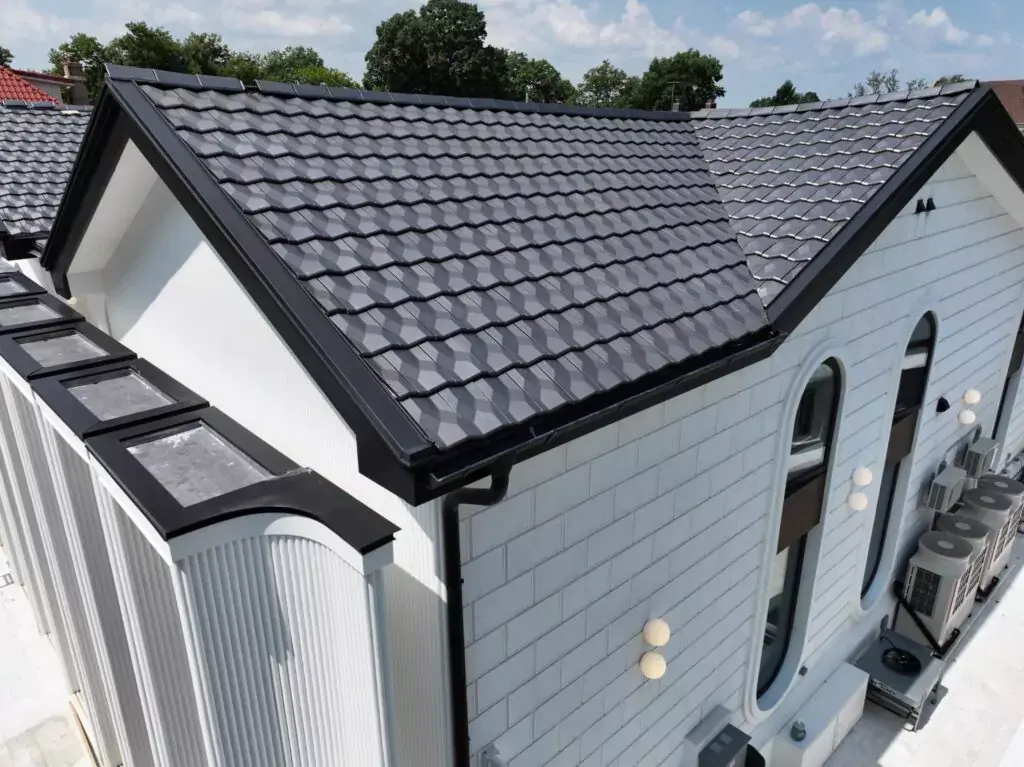
A glimpse at our premium roofing portfolio — from lakefront estates to architectural-committee-approved community installs.
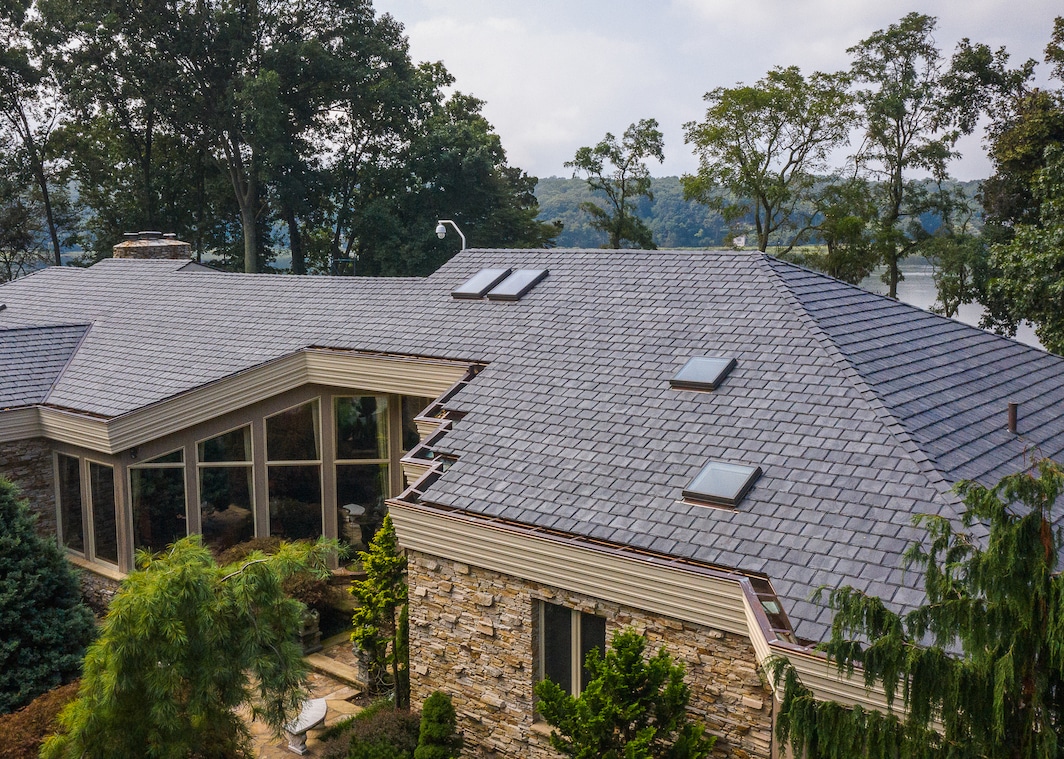
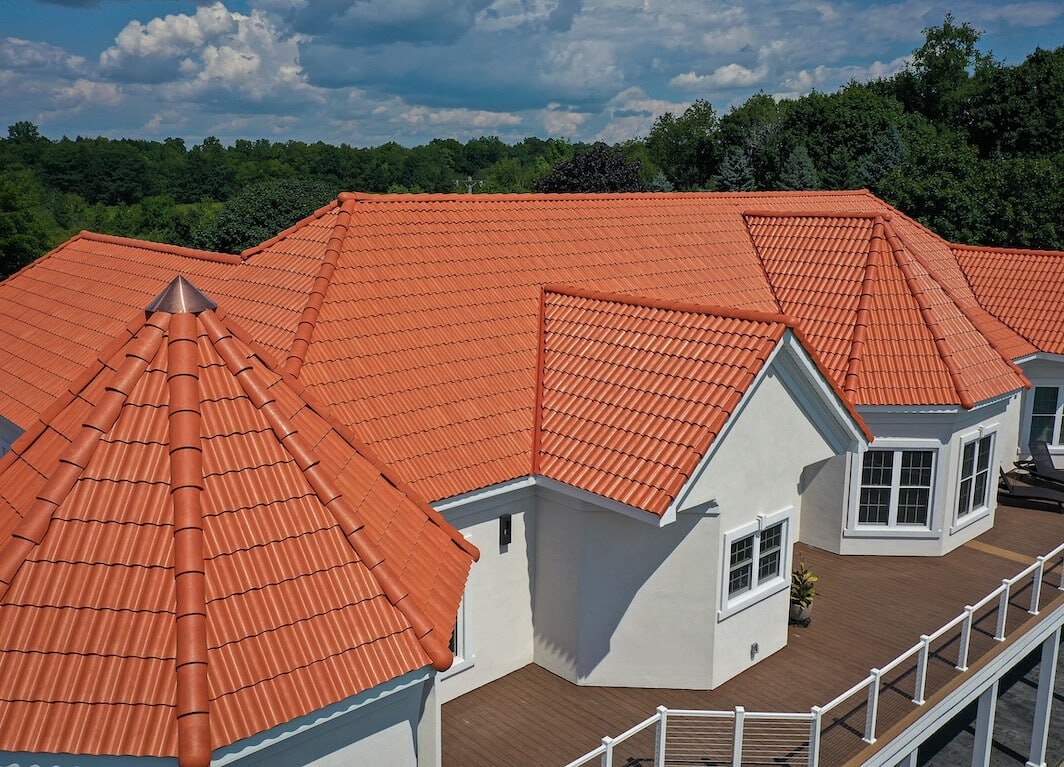

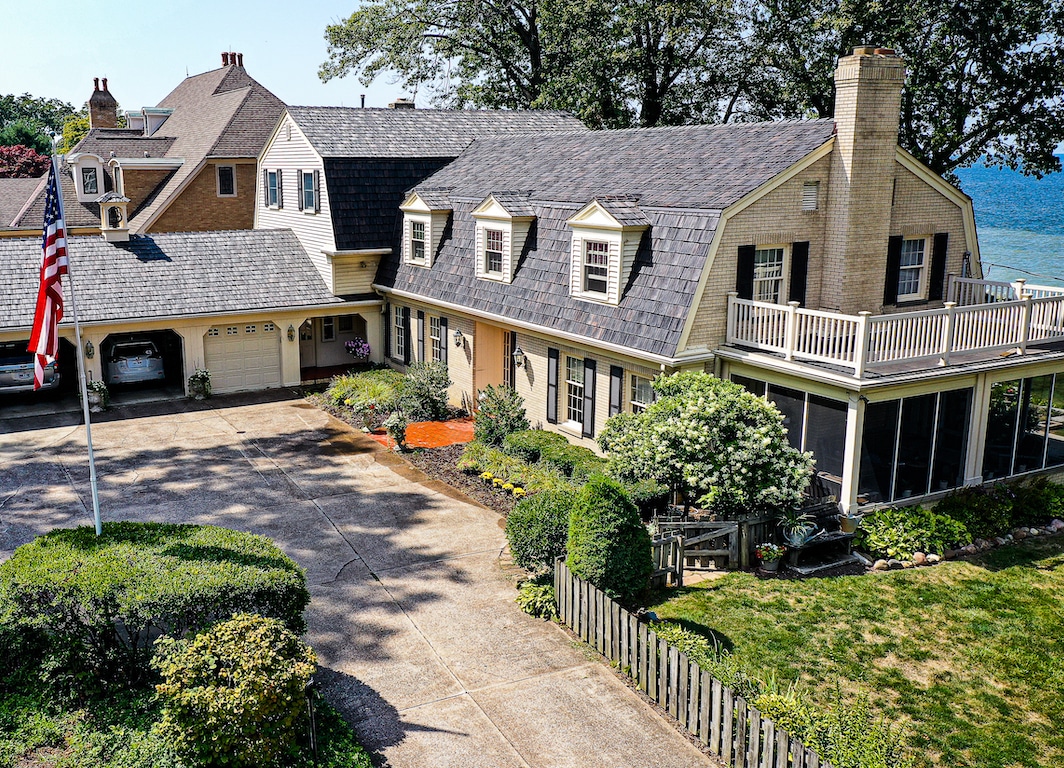
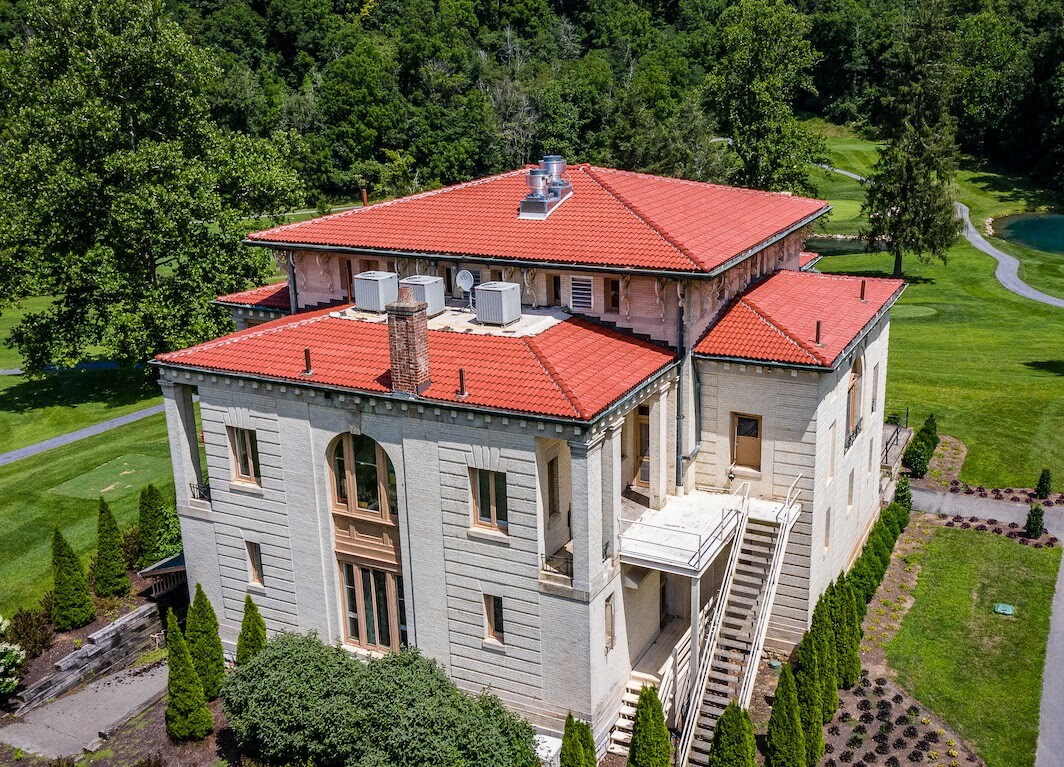
"We compared five roofers for our composite slate installation. Red Roofing was the only one who brought a structural engineer and actual material samples to the first meeting. The finished roof is stunning — and it came in on time."
"Brava composite tile on our coastal-style home. The installers knew the product inside-out, the copper flashing details look gorgeous, and the manufacturer rep signed off on the install for full warranty coverage. Worth every dollar."
"We wanted the slate look without the weight or the cost. Red installed DaVinci composite and you cannot tell it's not stone slate from the street. Fifty-year warranty and my insurance dropped too."
Composite synthetic slate and stone-coated steel typically run $8–$16 per square foot installed — significantly more accessible than stone-quarried alternatives while still offering 50+ year warranties. Polymer composite barrel tile and cedar shake fall in similar ranges. Every Red Roofing quote is itemized — no vague square-footage estimates.
Almost always, yes. That's the major advantage of lightweight composite systems — they weigh roughly 1/4 of stone-quarried slate (often 1.5–2 lbs per square foot vs. 8–15 lbs). Most Georgia homes built for asphalt shingles can accept composite slate or tile with no structural reinforcement at all. We confirm this with a free load analysis on every project.
Industry-leading composite systems (DaVinci, Brava, CeDUR) carry 50-year limited warranties. Stone-coated steel tile is rated for 50+ years. Polymer composite barrel and shake systems carry lifetime limited warranties from select manufacturers. Real-world performance frequently exceeds the warranty period.
Often yes. Class A fire rating, Class 4 impact rating, and hurricane ratings frequently qualify for insurance discounts — sometimes 15–30%. We'll provide documentation to submit to your carrier.
Yes. Modern composite systems are molded directly from natural slate, capturing every chip, edge, and surface variation. From street level — which is how virtually all roofs are seen — composite slate is visually indistinguishable from stone slate. We'll bring physical samples to your consultation so you can compare them yourself.
Yes — these are core markets for us. Dedicated crews for Lake Oconee (Reynolds, Great Waters, Cuscowilla), Greensboro's historic district, and surrounding communities including Madison, Eatonton, Athens, and Milledgeville.
Looking for tile and slate roofing in Georgia in a specific town? Explore our dedicated service pages for the lake and historic district communities we serve most.
Premium composite installations across Reynolds, Great Waters, Cuscowilla & surrounding lake communities.
Explore Lake OconeeComposite tile & slate installations across historic downtown Greensboro and Greene County.
Explore GreensboroFree consultations across Madison, Lake Oconee, Greensboro & all of Georgia.
Schedule a no-pressure tile and slate roofing in Georgia consultation with one of our specialists. We'll walk your property, discuss your goals, and leave you with honest material recommendations and a line-itemed quote.