
Roofer Atlanta, GA
Most of what makes a roof last happens in places you'll never see once the shingles are on. As the roofer Atlanta GA homeowners call for that work, we judge our crews on those hidden details, and this page shows you what they are.
- Our own crewsnot day labor picked up for the job
- Down to the deckevery old layer removed and inspected
- Red synthetic underlaymentacross the entire roof deck
- Magnetic sweepof yard, beds, and driveway on every job
The people who'll be on your roof
When you hire a roofer Atlanta GA homeowners recommend, the person who sold you the roof usually isn't the person who installs it. That's normal. What matters is who those installers are, who they answer to, and whether anyone checks their work. At Red Roofing & Gutters, the roofer Atlanta GA customers get looks like this:
- Your project manager writes the scope, orders the materials, and comes back to the house during and after installation. You'll have their name and number from the first day.
- The crew lead runs the installation: where the dumpster goes, how the property is protected, what order the roof comes off, and what gets photographed when the crew finds a problem under the old shingles.
- The installers are our own crews, people who work on Red Roofing roofs week after week and know how we expect each detail to be done.
- Our inspectors look at roofs every day and know what failed installations look like years later. That knowledge comes back to the crews as the standards they install to.
We install Owens Corning roofs as complete systems, following the manufacturer's installation requirements. You can look us up on the Owens Corning contractor locator. That isn't just a quality preference. It's what makes a roof eligible for the Owens Corning Preferred Protection warranty, which includes 10 years of workmanship coverage backed by Owens Corning. If a roofer cuts corners, that coverage is at risk. No roofer Atlanta GA homeowners hire from us is allowed to.
Craftsmanship you can't see from the street
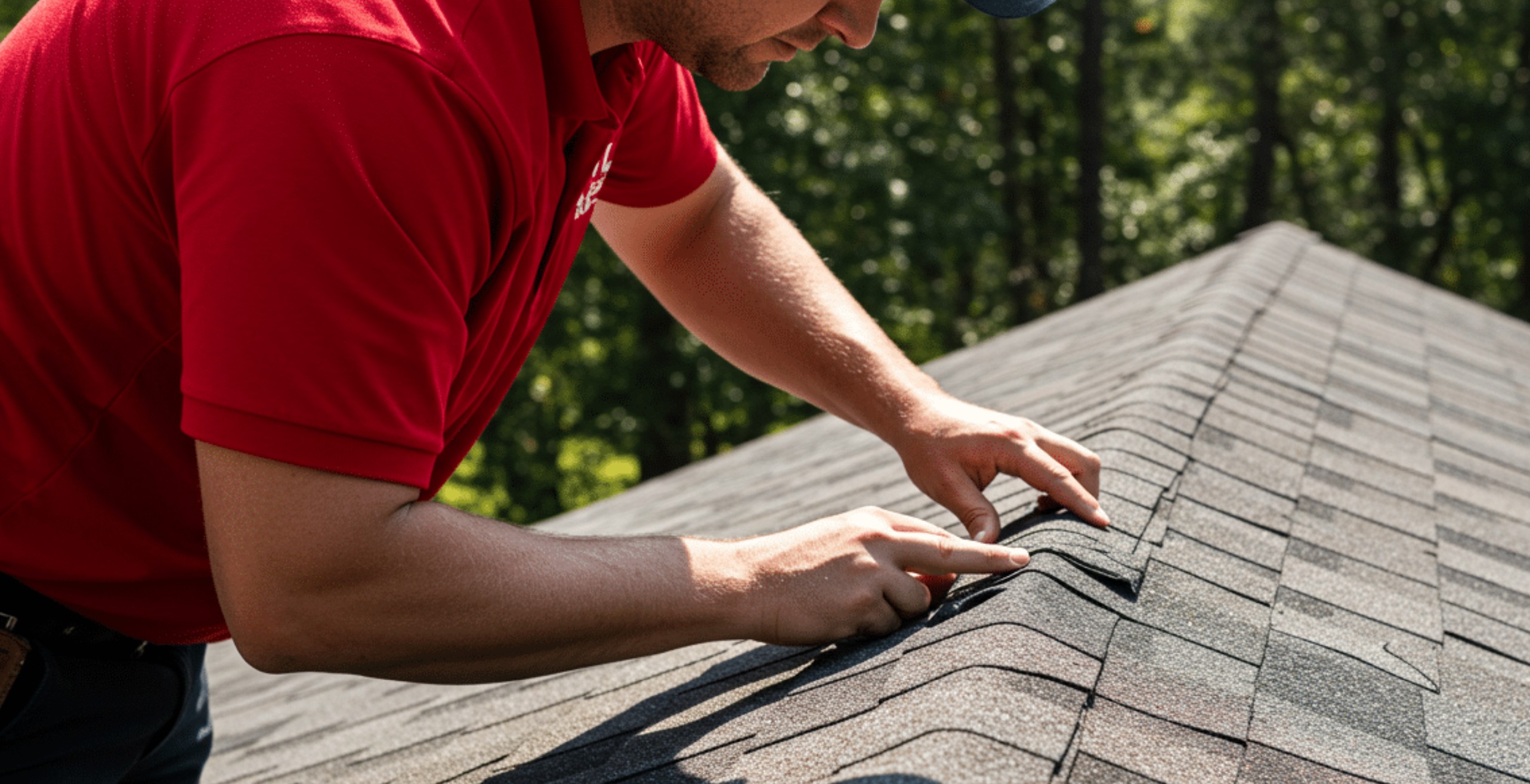
From the curb, a roof installed carelessly and a roof installed well can look exactly the same on the day the crew leaves. The difference shows up three, five, or ten years later as a leak over the bathroom or a row of shingles in the neighbor's yard after a storm. These are the layers every roofer Atlanta GA homeowners get from us builds, from the wood up, and what doing each one right actually means.
The deck
Once the old roof is off, the crew walks the entire deck. Wood that's soft, delaminated, or won't hold a nail is cut out and replaced, and the crew lead photographs it so you can see exactly what was found. Shingles nailed into bad wood loosen over time, no matter how good the shingles are.
Drip edge
Metal drip edge goes on the eaves and rakes to steer water away from the fascia and into the gutter. Its placement relative to the underlayment matters: on the eaves the drip edge goes under the underlayment, and on the rakes it goes on top, so water always laps over a seam instead of running into one.
Leak barrier in the weak spots
Self-adhering ice and water membrane goes in the valleys and around chimneys, skylights, and sidewalls, the places where water concentrates or changes direction. It seals around nails driven through it, which ordinary underlayment can't do.
Underlayment across the whole deck
Our red synthetic underlayment covers every square foot of the deck, lapped so that each course sheds water over the one below it. It's also what keeps the house dry if a storm pops up halfway through the job.
Starter strip
A dedicated starter shingle goes along the eaves and rakes. It gives the first course of shingles an adhesive edge to seal to, and that edge is what stops wind from getting under the roof and peeling it back.
Nailing
This is the detail that separates a careful roofer Atlanta GA homeowners can trust from a fast one. Each shingle has a nailing zone, and nails driven above or below it, or at an angle, or overdriven through the mat, don't hold the way the wind ratings assume. Our crews keep every nail inside the manufacturer's nailing zone and set their nail guns so nails sit flush with the shingle instead of being driven through it.
Valleys
Valleys carry more water than any other part of the roof, and in Atlanta they also collect pine needles and leaves. The valley method is chosen for the roof, and the shingles are trimmed and sealed so water can't be driven sideways under them.
Flashing at walls and chimneys
Step flashing is woven in with each course where the roof meets a sidewall, and counter-flashing covers it at chimneys. At the bottom of a roof-to-wall joint, a kick-out flashing directs water into the gutter instead of down the wall. Missing kick-outs are one of the most common causes of hidden wall rot any roofer Atlanta GA homes hire will find.
Pipe boots and vents
Every plumbing vent gets a new boot. Old rubber boots crack in the Georgia sun, and reusing them is the easiest way for a roofer Atlanta GA homeowners don't know to save a few dollars at your expense.
Ridge and ventilation
The ridge is cut open for exhaust ventilation where the roof design calls for it, then capped with matching hip and ridge shingles. The crew checks that intake at the soffits is clear, because exhaust without intake doesn't move air through the attic.
How a roofer Atlanta GA weather tests builds for local conditions
A roof in Atlanta fights a different set of enemies than a roof in Denver or Boston. As Atlanta roofers, we adjust how we build to the conditions your roof will actually face here.
Heat in the attic
Every roofer Atlanta GA summers keep busy knows this one. On a July afternoon, an attic in Atlanta with poor ventilation can get dramatically hotter than the air outside. That heat bakes shingles from below, shortens their life, and makes your air conditioner work harder. Before we install a roof, we look at how much intake and exhaust ventilation the attic has.
Building codes generally call for a set amount of net free vent area based on the attic floor size, split between low intake vents and high exhaust vents. If the attic is short on intake, adding more exhaust won't fix it. It can even pull conditioned air out of the house. Getting this balance right is one of the most valuable things a roofer Atlanta GA homeowners hire can do, and one of the most often skipped.
Humidity and algae
The black streaks on so many Atlanta roofs are algae, and they thrive in our humid summers, especially on north-facing slopes and roofs shaded by trees. We install shingles with algae resistance built into the granules, so a new roof stays clean far longer than an old one did. If you have streaks now, don't let anyone pressure-wash the roof. High-pressure water strips granules and shortens shingle life.
Trees, debris, and shade
Atlanta's tree canopy is one of the best things about living here and one of the hardest things on a roof. Debris builds up in valleys and behind chimneys, holds moisture against the shingles, and blocks water from draining. Our crews pay extra attention to valley construction under heavy canopy, and they'll point out limbs touching or hanging over the roof, which scrape shingles in the wind and drop onto the roof in storms.
Wind and hail
Spring storms in Metro Atlanta can bring straight-line winds and hail, and the National Weather Service Atlanta office tracks them for every county we serve.
Wind resistance comes down to the starter strip, the sealant strips, and the nailing, which is why we spend so much time on them. For homeowners who want more protection from hail, we can install impact-resistant shingles, which are designed to take hail hits with less damage. Some insurers offer a discount for them, so it's worth asking your agent.
The materials our roofer Atlanta GA crews install
A good roofer in Atlanta has to know more than one kind of roof, and every roofer Atlanta GA homeowners trust with older homes should. The metro has 100-year-old slate, brand-new standing seam metal, and every kind of shingle in between. Each material asks something different of the people installing it.
| Material | Where it fits in Atlanta | What the roofer has to get right |
|---|---|---|
| Architectural asphalt shingles | Most homes across the metro, from intown bungalows to suburban two-stories. | Nailing placement, starter and sealant strips, and a complete matched Owens Corning system for warranty coverage. |
| Impact-resistant shingles | Homes in hail-prone areas, or owners who want to reduce storm risk. | The same installation precision as standard shingles. Impact ratings assume the shingle is installed exactly to spec. |
| Standing seam and metal roofing | Modern homes, farmhouse styles, porches, additions, and outbuildings. | Panel layout, fastening that allows the metal to expand and contract in Atlanta heat, and clean trim at every edge. Learn more about our metal roofing. |
| Tile and slate | Historic homes and high-end properties in neighborhoods like Buckhead and Druid Hills. | Walking the roof without breaking pieces, matching replacements, and flashing details that last as long as the stone. See our tile and slate roofing page. |
| Low-slope membranes, including TPO | Porch roofs, rooftop decks, additions, and commercial buildings. | Seam welding or sealing, drainage, and transitions where a flat section meets a sloped roof. |
A common mistake is putting shingles on a section that's too flat for them, like a low porch roof on an older intown home. Shingles need enough slope to shed water. Below that, a roofer Atlanta GA homeowners can trust will switch to a membrane or metal, even if it means two materials on one house.
Protecting your home while we work
A roof replacement is loud, dusty, and busy for a day or two. Good roofers in Atlanta make it as easy on you and your property as they can. Here's what our crews do, and what you can do to help.
What our roofers in Atlanta do
- Cover shrubs, flower beds, and air conditioning units with tarps before the tear-off begins.
- Lean plywood against windows and walls below the work area, and protect decks and patios.
- Place the dumpster or trailer where it won't crack your driveway, with boards under it when needed.
- Run magnets over the lawn, beds, and driveway at the end of each day, not just the last one.
- Clear shingle grit and debris out of the gutters before they leave.
What you can do
- Move cars out of the garage and driveway the morning work begins.
- Cover belongings in the attic with sheets. Tearing off a roof shakes loose dust and debris.
- Take pictures and mirrors off walls on the top floor. Hammering can rattle them loose.
- Keep pets and kids inside or away from the house during tear-off.
- Let your neighbors know. They'll appreciate the heads up about the noise and the trucks.

How to check a roofer Atlanta GA job after it's done
You don't need to climb a ladder to tell a lot about how carefully a roofer worked. Walk around the house with this list after any roof installation, ours included. If something looks off, call your project manager. A good roofer Atlanta GA homeowners trust would rather fix it now than hear about it after a storm.
Our project managers walk the finished roof with every homeowner and share the photos from installation day, so many of these questions get answered before you have to ask them.
Questions to ask your roofer before installation day
The best time to clear up questions is before the dumpster arrives. Whether you hire us or another company, these are the questions we'd want answered if it were our house. Any good roofer Atlanta GA homeowners interview should be able to answer them without hesitating.
"Who will actually be on my roof?"
Ask whether the installers are the company's own crew or a subcontractor, and which roofer Atlanta GA crew lead is in charge on site. You want a name for the person you can talk to on installation day if something comes up.
"What happens to my landscaping?"
Point out any plants, beds, or features that matter to you, and ask how they'll be protected. If you have a garden, a koi pond, or a new patio, the crew needs to know before the tear-off starts, not after.
"How will you handle ventilation?"
Ask whether the roofer looked at your soffits and attic, and what intake and exhaust they plan to install. A vague answer here is a red flag, because ventilation directly affects how long the new shingles will last in Atlanta's summers.
"What will you replace, and what will you reuse?"
Drip edge, pipe boots, and flashing should be new, not reused from the old roof. If your roofer plans to reuse anything, ask why. Sometimes there's a good reason, like original copper flashing on a chimney that's still in great shape, but you should hear the reason.
"Where will the dumpster and materials go?"
Shingle deliveries are heavy, and the dumpster for an Atlanta tear-off can be large. Decide together where they'll sit, especially on steep intown driveways or in neighborhoods with HOA rules about street parking.
When a roofer Atlanta GA homeowners trust should say "not yet"
Not every roof that looks tired needs replacing, and experienced Atlanta roofers know the difference. Algae streaks are cosmetic. A handful of missing shingles after a windstorm is usually a repair. A single leak around a chimney is almost always a flashing problem, not a roof problem. A trustworthy roofer Atlanta GA homeowners call will tell you that, even if it means a smaller job.
Our inspectors look at the age of the roof, granule loss, how the shingles are sealing, the condition of the decking from the attic, and the pattern of any damage. If a repair will buy you years, we'll recommend the repair. If the roof is at the end of its life, we'll show you why with photos, not just tell you.
If you're dealing with a leak right now, our Atlanta roof repair and leak detection team is the place to start. For price ranges on a full replacement, see what a roof costs in Atlanta.
More on roofing in Atlanta
Questions about our roofer Atlanta GA crews
Do you use subcontractors, or your own roofers?
Every roofer Atlanta GA homeowners see on a Red Roofing job is part of our own crews, who work on Red Roofing & Gutters jobs week after week and install to the same standards on every house. Your project manager oversees the job and is your contact the whole way through.
Do I need to be home while the roofers work?
You don't have to be home while a roofer Atlanta GA crew is working, but we ask that someone be reachable by phone. We'll need the driveway clear and access to an outdoor outlet, and if the crew finds damaged decking, your project manager will want to show you the photos before the roof is closed up.
Will the roofers need to go into my attic?
Usually only for a quick look. Your inspector checks the attic during the inspection to see the decking and ventilation. During installation, the crew may check ventilation or look for light coming through the deck, but most of the work happens from the outside.
What happens if the roofers find rotten wood?
Your roofer Atlanta GA crew lead stops, photographs it, and lets your project manager know. Damaged decking is replaced at the per-sheet price listed in your estimate, so there's no guessing about the cost once the old roof is off.
What if it starts raining in the middle of the job?
Our roofers in Atlanta only open as much roof as they can dry in that day. The synthetic underlayment and leak barrier keep the house dry, and the crew covers any exposed areas before they leave if weather is coming.
Can your roofers fix the black streaks on my roof?
The streaks are algae. On an existing roof, a gentle cleaning treatment can remove them for a while, but never a pressure washer. On a new roof, we install shingles with algae resistance built in, which is the long-term fix.
Can you install a roof color my HOA will approve?
Yes. We'll give you the product name, color, and specification sheets your HOA asks for, and we won't schedule the installation until you have the approval in hand.
Have a roofer Atlanta GA homeowners trust take a look
Book a free inspection with the roofer Atlanta GA homeowners recommend. We'll check the roof and the attic, photograph what we find, and give you a straight answer about what your roof needs.